
|

Everything to Know About Lead-Lining
 Other News
Subscribe to FREE newsletter
Other News
Subscribe to FREE newsletter
| Aug 24, 2026 |
Lead lining is the installation of sheet lead within walls, floors, ceilings, doors, and other structural assemblies to block harmful X-ray and gamma radiation.
Facilities use it to protect staff, patients, and the public from radiation exposure generated by imaging equipment, radiation therapy systems, and nuclear medicine procedures.
Because lead is dense, malleable, and cost-effective, it remains the most widely used material for room shielding in medical and industrial construction.
Common Uses for Lead Lining
Lead lining is a standard requirement across a broad range of facilities wherever radiation-generating equipment is in use.
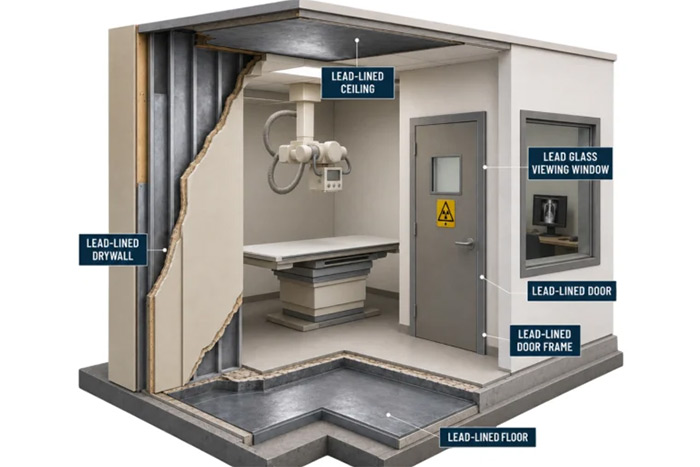
Medical imaging rooms are among the most common applications. Diagnostic X-ray, CT, fluoroscopy, and MRI-adjacent rooms all require shielded walls to prevent scatter radiation from reaching adjacent spaces, hallways, and waiting areas.
Hospitals and cancer treatment centres use lead lining in radiation therapy vaults and linear accelerator rooms, where shielding requirements are significantly higher than in standard diagnostic imaging.
Dental clinics require lead lined walls in X-ray rooms to protect staff and patients in adjacent areas from low-energy diagnostic radiation.
Veterinary imaging rooms follow the same shielding principles as medical facilities. As veterinary clinics increasingly adopt digital X-ray and CT equipment, lead lining has become a standard construction requirement in these environments as well.
Nuclear medicine and PET suites require heavier shielding than standard X-ray rooms due to the higher energy gamma radiation involved. Lead lining thickness in these spaces is determined by a qualified medical physicist.
Lead Lining Installation Methods and Products
Several products deliver lead lining depending on the construction type, shielding requirement, and whether the project is new construction or a retrofit.
Lead lined drywall bonds sheet lead directly to gypsum board, allowing standard drywall installation workflows while incorporating radiation shielding into the wall assembly. It is one of the fastest installation methods for new construction and retrofits alike.
Lead lined plywood attaches sheet lead to a plywood backing, providing a structurally robust substrate suited to heavier shielding requirements or installations where additional wall rigidity is needed.
Lead lined doors maintain shielding continuity at room openings, which are otherwise a gap in the overall assembly. Doors are available in a range of configurations and shielding thicknesses to match the surrounding wall specification.
Lead glass and lead lined frames provide shielded viewing windows in walls and doors, allowing operators to maintain sightlines into the room without stepping outside the shielded zone.
Lead batten strips and discs cover joints, screw heads, and door hardware to eliminate gaps in shielding continuity at transitions and penetrations.
Lead rolls are simply the same material supplied in a continuous roll. It makes it easier to handle on-site and cuts down on seams. Both are widely available and suit retrofit projects or any situation where a pre-laminated board is not the right fit for the job.
With that said, shielding thickness for any lead lined room should be specified by a qualified medical physicist. Ultraray supplies the full range of lead lining products for medical, dental, veterinary, and industrial applications. Contact Ultraray to discuss your project.
#Ultraray #RadiationProtection #RadiationSafety #PureLead #SheetLead #Lead

For other relevant searches, you might want to try: